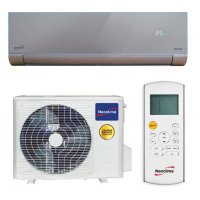
The difference between an inverter and a conventional non-inverter air conditioner
One of the most common questions about air conditioners that arises when choosing it: “What is the difference between an inverter air conditioner and a conventional one?” And if it’s not difficult to figure out the rest of the functional set, then with their types and principle of operation, not everything is so simple.
What is the difference between an inverter air conditioner and a non-inverter air conditioner?

Temperature regime. The main difference between an inverter air conditioner and a non-inverter one is their temperature regime. A non-inverter air conditioner during heating can operate up to -7 ° C cold outside the window. While the inverter can withstand temperatures down to -30 ° C and can act as the main local source of space heating.
The principle of operation of the compressor is another important criterion, how an inverter air conditioner differs from a conventional one . The non-inverter air conditioner accelerates the compressor completely, reaches the desired temperature and turns off. When the room temperature changes, the process is repeated. We can say that the compressor of a non-inverter air conditioner works in jerks - from minimum to maximum. The inverter air conditioner, when the set parameters are reached, does not turn off completely, but operates at low speed, thus maintaining the temperature. With this principle of operation, there is no need to load the compressor to the maximum.
Options. It is believed that the inverter air conditioner maintains the temperature set by the settings better. The difference can be up to 1°C for an inverter and 3°C for a non-inverter.
What is the difference between an inverter air conditioner and a conventional one - inverted air conditioners are quieter due to the fact that the compressor runs smoothly and smoothly, unlike a non-inverted air conditioner, which has a different operating principle.
Price. Another important factor of how an inverter air conditioner differs from a non-inverter one is that inverters are more expensive than conventional air conditioners.
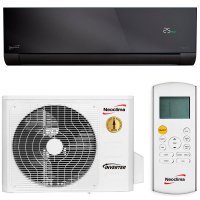
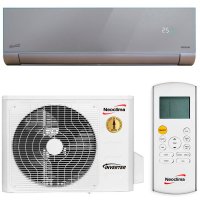
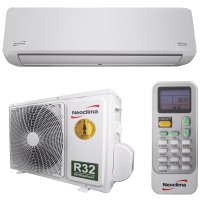
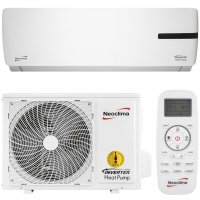
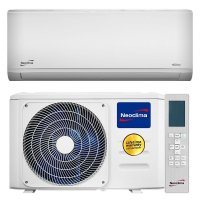
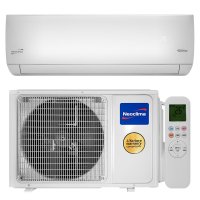
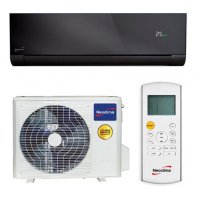
The main features of Neoclima inverter air conditioners:
- Neoclima inverter split systems operate from minus 15 С° to minus 30 С°;
- Support WiFi control;
- Built-in ionizer - air purification from harmful particles (allergens, viruses, bacteria, fungal spores) and blood saturation with negative ion particles, which improves brain performance and general condition of the body;
- Cold Plazma filter - updated ionizer;
- Filters: carbon, HEPA filter, coarse filter, kahetin, antibacterial;
- Function I - Feel - the built-in sensor in the control panel measures the temperature and sends a signal to the air conditioner, which in turn works to achieve the measured parameters;
- Function +8 - maintains the temperature in the room within 8 degrees;
- 4-D AirFlow - control of horizontal and vertical blinds;
- Smart function - automatic control of the operating mode;
- Dimmer function - dims the backlight during a night's sleep;
- Self-cleaning and self-diagnosis function;
- 360°D inverter technology;
- Intelligent defrosting;
- Compressors from world brands;
- Hydrophilic coating of the heat exchanger;
- Low noise level;
- Warranty 24 months.
The main features of Neoclima non-inverter air conditioners:
- Neoclima non-inverter split systems work for heating at temperatures down to -7 C ° outside the window;
- A series of mobile portable air conditioners Neoclima ;
- Support WiFi control;
- Smart function - automatic control of the operating mode;
- Function I - Feel - the built-in sensor in the control panel measures the temperature and sends a signal to the air conditioner, which in turn works to achieve the measured parameters;
- Turbo function;
- Self-cleaning function;
- Automatic mode switching;
- Compressors from world brands;
- Soft dehumidification;
- Hydrophilic coating of the heat exchanger;
- Coarse filter;
- Low noise level;
- Stylish design
- Warranty 24 months.
To understand how an inverter air conditioner differs from a conventional one, our experts will help you choose a household split system according to the necessary parameters here or by calling: 0 800 50 70 25
Related Posts
The best home air conditioners. Which split to choose and how to

Split system Neoclima is a device that regulates the temperature in the house according to the specified parameters. It consists of two blocks - inter..
Household air conditioner with ionizer - air conditioner air ionizer

An ionizer is a device that purifies the air by filling it with charged, negative particles of ions. When the concentration of negative particles beco..
Buying an air conditioner in installments, paying in installments: profitable and convenient

Buy an air conditioner on credit in the Neoclima online store. What is needed for this and how to arrange payment in installments or instant installme..
Reliable and correct choice of air conditioner

How to choose the right air conditioner? The main question when buying an air conditioner home. Neoclima will help you figure out how to choose a reli..
Can an air conditioner be harmful to a person. Cold, air conditioner allergy

Often the question arises whether it is possible to get sick from the air conditioner. Such cases do occur. Especially more often with children. But w..
Air conditioner and baby. Benefit, harm and rules of use

At the time of making the decision to buy and install an air conditioner, many parents have the question: "Won't it be harmful to the child?". Neoclim..
Is it possible to turn on the air conditioner in winter for heating?
Is it possible to turn on the air conditioner in winter for heating? At what temperature can the air conditioner be turned on for heating? Let's figur..
Neoclima winter kit for air conditioners
"Winter set" on the air conditioner for heating - allows you to work, even a non-inverter split system at low sub-zero temperatures down to -25 ° C. D..
List of TOP 5 inverter air conditioners Neoclima

Rating TOP 5 inverter air conditioners for heating from TM Neoclima. Which air conditioner with heating is better and more accurate for you. Features ..
Neoclima air conditioner as the main or auxiliary source of heating
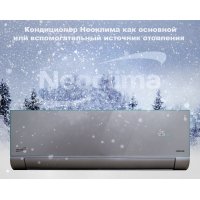
A heat pump is the principle by which it makes sense to purchase an air conditioner for heating. This is the fundamental difference between it and any..
Wi-Fi air conditioner with Wi-Fi - Control Air Conditioner from the Phone
What is WiFi Air Conditioner - This is a household air conditioner that can be controlled using a smartphone through the WiFi network. The Neoclima co..
Dismantling the split system or how to properly dismantle the air conditioner
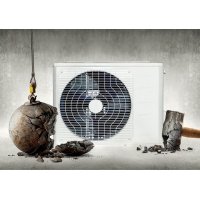
The process of dismantling the air conditioner may seem simple enough, but this is only at first glance. To dismantle the air conditioner, you must fo..
When, why and how to clean the air conditioner?

The air conditioner is designed to create a comfortable indoor climate, which helps a person survive a hot or cold period or season. But, like many de..
How and how much does it cost to install a split system air conditioner in Ukraine

After buying an air conditioner, the first thing a consumer faces is its installation. This article will help you understand the installation of a hou..
The choice of the most optimal air conditioner option for an apartment and a house?
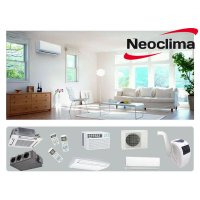
The right choice of air conditioner in the house or apartment. Optimum power and model. Parameters by which to choose an air conditioner...
Ionization in Neoclima air conditioners

An article about Ionization in Neoclima air conditioner split systems. What is air ionization and why is it important in air conditioners. The functio..
Neoclima air conditioners - a smart solution with a fresh mind!

Combining high efficiency, uncompromising quality, beautiful design and affordable price, Neoclima air conditioners will be a smart solution for both ..
REBRANDING NEOCLIMA: THE CLIMATE BRAND HAS BEEN REBRANDED

NEOCLIMA CLIMATE BRAND REBRANDED..