
Semi-industrial air conditioner is an optimal alternative to household air conditioners
"1-2 options, would simplify the choice" - one of the most common phrases that we hear as an official representative of climatic equipment in Ukraine. The variety of products in this direction will not leave anyone indifferent, and even more so a person who has set a goal to acquire an air conditioning system.
The right choice is 50% of the result.
And so, let's go in order.
Initially, air conditioning can be divided into types:
1. Household air conditioners;
2. Multi-split systems;
3. Semi-industrial systems.
Household air conditioners or split system features
Household air conditioner is a device of local action, consisting of one indoor and outdoor units. It can be used as the main, but more often - a backup source of heat or cold. It is installed, as a rule, in places of household use: apartment, house, cottage, store, office premises or any other place that does not require a complex design solution or installation.
Multi-split system is essentially the same household air conditioner, the peculiarity of which is the possibility to connect up to 5 indoor units to one outdoor unit. Thus creating a separate air conditioner for each room.
Key features: four basic modes of operation (cooling, heating, dehumidification, ventilation), remote control via Wi-Fi, intelligent control system, self-cleaning, ionization, multi-level filtration, work for heating up to minus 30 ° C, treatment of rooms up to 70 sq.m., etc.
Semi-industrial systems - their types - specifics of work
Until recently, in the vast majority of cases, this direction of air conditioning was considered for public facilities or any other buildings with a large area. Today, given the level of market development, we can safely say that such systems are applicable in most cases, depending on the type of building and the task at hand.
Cassette type air conditioner. To a standard outdoor unit, small-sized (square-shaped) systems are connected. They are built into a suspended ceiling or a special panel closer to  the center. Such installation makes them invisible due to their size and special design.
If there is a suspended ceiling and sufficient height, this air conditioner is compatible with any type of premises - from a private house to public places.
Most often used: in office buildings, places of large crowds of people (shopping centers, catering, government agencies, stores, etc.). Cassette type air conditioner price is lower than several standard split systems.
Key features: basic modes (cooling/heating); support for heating option up to -23 ° C; cassette TM Neoclima with capacity of 5.27 kW-10.54 kW, which is equal to the average treated area: 50 - 100 sq.m.; air supply in 7 directions; possibility of fresh air inflow; double protection against condensate leakage, freon evaporation control; built-in drain pump.
Floor-ceiling air conditioner. System in the form of outdoor and indoor units - flat, rectangular shape, which is fixed to the wall. Its peculiarity is that the installation is close to 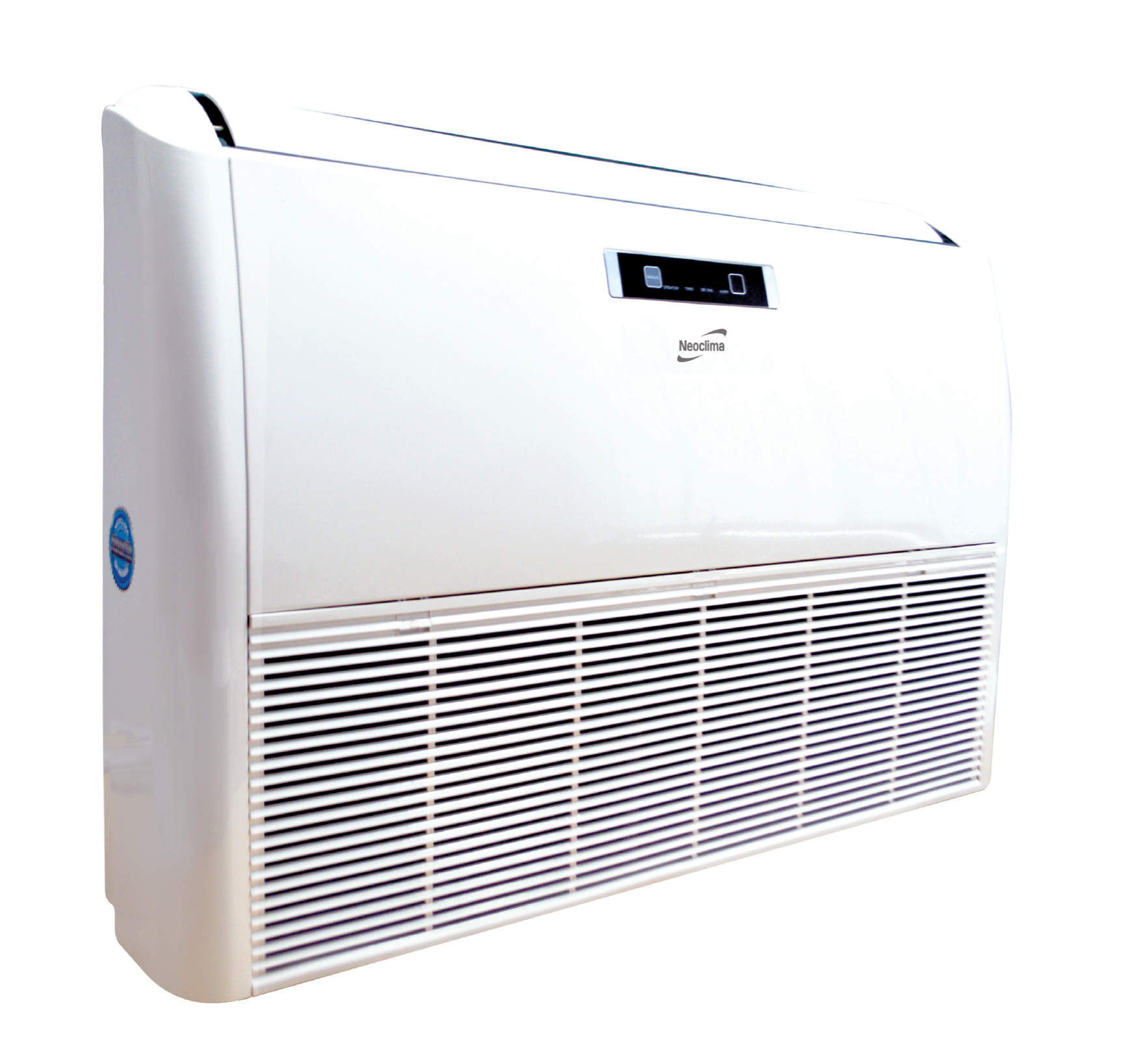 universal, when the solution can be found in the form of installation under the ceiling or closer to the floor. The air flow is directed along the wall or ceiling, which distributes it throughout the room more evenly without hitting the person.
Most commonly used: compatible with all types of rooms and buildings, from residential to industrial, public places. Including buying a floor-ceiling air conditioner can be for buildings with a specific shape, such as rectangular (oblong) shape.
Key properties: four basic operating modes (cooling, heating, dehumidification, ventilation); support of air conditioner operation in heating mode up to -23 °С; produced in the range of power - 5.27 kW to 17.58 kW, which is equal to 50 sq.m. - 170 sq.m. of served area in average; function of automatic rocking of vertical and horizontal shutters; simple installation; control of freon evaporation.
Duct air conditioner. A special system that is designed to control and change the air temperature in rooms from the smallest to 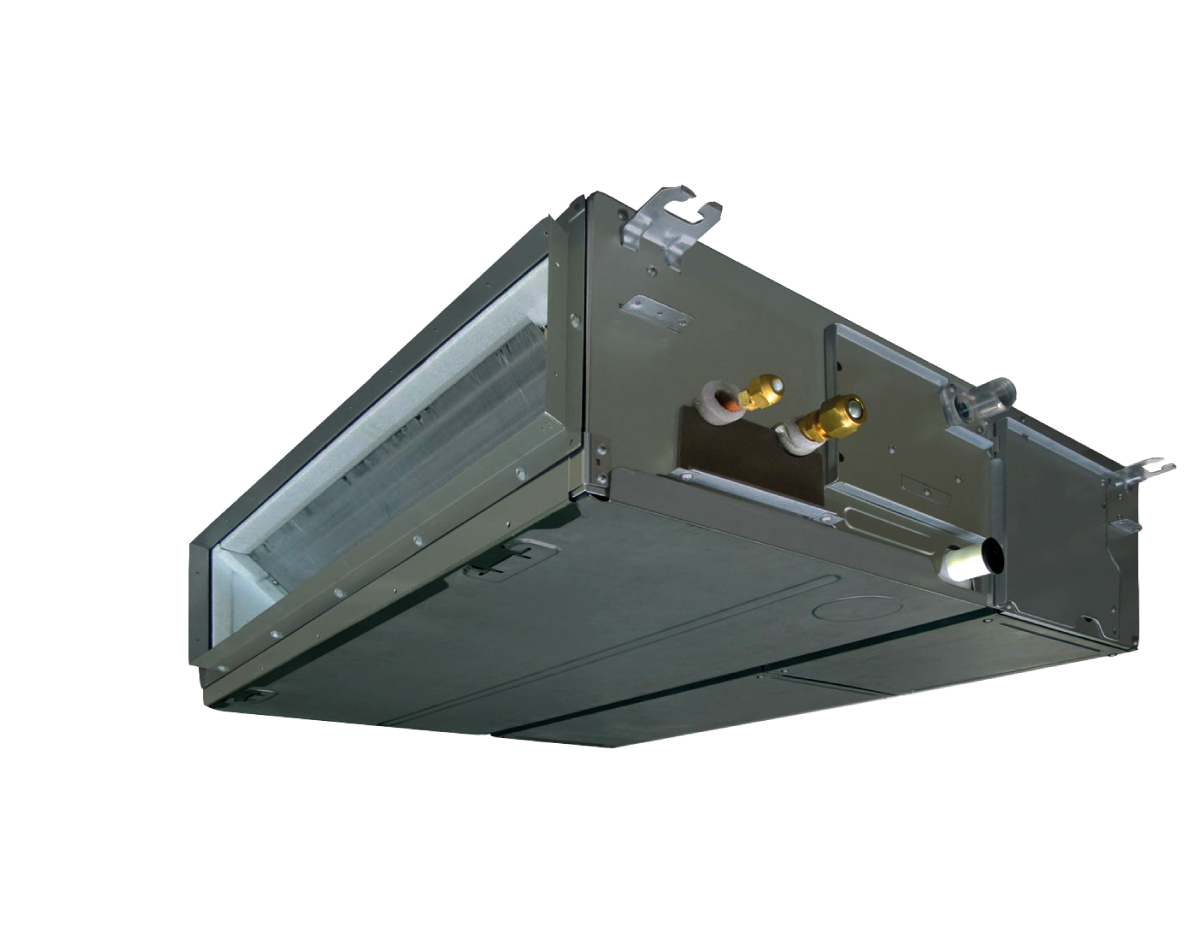 industrial size without changing the design and its appearance in general, as it has a hidden installation. Installation is carried out in a suspended ceiling or utility room with further wiring throughout the building where air treatment is planned. Air passage and air intake flanges are designed for easy connection. Inverter duct air conditioner has special openings in the body of the unit for fresh air inflow and ventilation organization, which is an important component, especially in places of large gathering of people.
Most often used: in places of public use (shopping centers, cafes, restaurants, stores, enterprises, warehouses, medical or educational institutions), office buildings, private houses, cottages, apartment buildings (more often at the stage of construction).
Key features: modes of operation (heating/cooling/ventilation/air supply from the street); mode of operation for heating up to -23 ° C; a variety of capacities from 5.27 kW to 17, 58 kW, which is equal to an area of 50 sq.m. to 170 sq.m.; automatic restart mode, which allows you to return to the previous settings in case of an unexpected shutdown or power surges; self-diagnostics, where the microprocessor monitors and controls the system; smart temperature control system in automatic mode.
The heart of the climate system is the compressor, and this is one of the key features and at the same time - the difference
If about the main thing and in 2 words:
Non-inverter or On/Off type of compressor. Supports the option of heating up to -7 ° C cold outside. The principle of operation - cyclic (jerks), when when the set parameter is reached, the compressor stops and resumes operation when the temperature deviates from the set norm. Air conditioners of this type work louder, have greater wear and tear, but at a cheaper cost.
Inverter compressor. The temperature range for heating is extended to -30 ° C of frost outside the window. This type, when reaching a given parameter, does not stop its work, but only reduces the speed, which allows you to accurately maintain the temperature (with an error of +/-1 ° C), save electricity consumption, the noise from them is less. These systems are more expensive than non-inverter air conditioners, but they have more possibilities.
