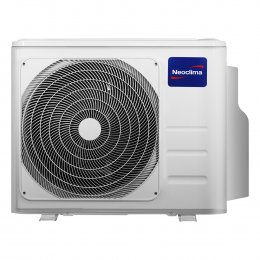
Neoclima NS-09TSI - Indoor cassette type

Safe, environmentally friendly and efficient European-level refrigerant
The service life of a household appliance can be divided into 2 responsible parties, whose actions determine the quality, quantity and duration of the product's life.
The manufacturer. Manufacturing of equipment in accordance with European standards, a contract with global manufacturing plants, no savings on spare parts and components, and the use of modern technologies will make it possible to launch a decent product on the market.
User. Observance of the proportion in the form of applying the manufacturer's rules prescribed in the instructions, organizing regular support and maintenance, and product storage conditions will extend the period of use without additional problems.
Let's take a closer look.
General recommendations:
1. Selection.
An important component is one of the first steps that will determine the final result.
The level of knowledge of engineers directly related to the product will help you choose the type of equipment, taking into account all the features of the building, optimal technical solutions and the needs of the customer.
2. Installation
An official installation company is the second most important stage after choosing an air conditioner. The qualifications of the craftsmen will allow you to take into account all the features and nuances, which guarantees the long service life of the system itself and its correct operation.
Install vibration supports/vibration dampeners - they will smooth out the noise from the outdoor unit.
Make sure that the technician makes a special note of the work in the warranty card.
3. Manual.
Unfortunately, for most people, the user manual is equated with waste paper that is not worthy of attention. However, this opinion is wrong, because the manual contains key information for the consumer and answers to most questions that are formed jointly with the manufacturer based on the individual characteristics of the product. We strongly recommend that you do not neglect the study of this document.
4. Temperature conditions
Familiarize yourself with the operating temperature limits set by the manufacturer. The use of the system, whether domestic or semi-industrial, outside these limits (each mode has its own), is fraught with malfunction or damage.
5. Minimum and maximum
As a rule, the manufacturer gives minimum and maximum temperature limits. However, engineers do not recommend going down/up to the limit parameters, as the system works to wear, which reduces its service life and affects the quality of the result.
6. Closed windows
It is important to understand that the air conditioner is a localized device, so when you turn it on, close the windows and doors. Otherwise, its operation will be useless, as the cold/heat will evaporate, and the system itself will switch to the high power mode, which entails additional energy consumption, clogging and wear and tear.
Care recommendations:
1. Maintenance
Maintenance is a series of actions taken in advance to prevent breakdowns, incorrect functioning and failure of the climate control equipment.
The service technician provided by the manufacturer will perform a deep cleaning, diagnose errors, check the freon level and refill if necessary.
It is recommended to perform maintenance 1-2 times a year.
2. After-sales service
The manufacturer's service specialists are qualified craftsmen who have undergone specialized training on the brands served. We strongly recommend that you do not use third-party services to avoid aggravation of the problem over time and to maintain the warranty.
3. Spare parts and accessories
Use original spare parts and components. Any, even the best analog, does not provide guarantees on the output, and in some cases, it will only worsen the situation.
4. Filter
It is recommended to clean the system through the manufacturer's service department.
To clean it yourself, read the instructions carefully.
Before any manipulations inside the system, it must be de-energized. After opening the air intake grille, act strictly according to the rules specified in the instructions.
The filter may be cleaned with a vacuum cleaner, brushes, water, or a mild detergent solution. Wipe/dry in a cool place. Do not expose to direct sunlight or contact with fire.
5. Housing
Do not clean the case with products containing chemical or any other aggressive components. This will disrupt the coloring and damage the plastic itself, and getting inside the unit will cause negative and possibly irreversible consequences.
Use a cloth or soft sponge moistened with running water. For grated surfaces, use soft brushes or cotton swabs.
Under no circumstances should you attempt to wash or clean the system from the inside by yourself, contact a service center for such measures.
We recommend that you carefully read the manual, which contains detailed rules, tips, technical information and equipment features.
Specification Neoclima NS-09TSI - Indoor cassette type
| General characteristics | |
|---|---|
| Recommended room area, sq.m | up to 25 |
| Compressor type | Inverter |
| Compressor | Toshiba GMCC |
| Installation | In the suspended ceiling |
| Indoor block size (L/H/D), mm | 570/570/260 |
| Weight, kg | 2,5 |
| Remote control | + |
| Case color | White |
| Made in | China |
| Factory | Midea |
| Warranty, mon | 24 |
| Functions | |
| Operating modes | Cooling/Heating/Ventilation/Drying |
| Air flow | 4 directions |
| Mixing fresh air | + |
| Automatic restart | + |
| Self-cleaning | + |
| Filters | 1 |
| Technical specifications | |
| Power, BTU/hour | 9000 |
| Power supply, V | 220-240 |
| Power consumption (heating/cooling), kW/h | 0,06 |
| Noise level, dB | 39/35/32 |
| Protection against voltage drop | + |
| Protection class | IPX4 |
| Freon (refrigerant) | R32 |
| Product Details | |
| # | 962 |
Downloads
Payment and delivery