What to choose for store heating - air conditioning, electric heater or thermal curtain
In anticipation of a cold snap, it is worth thinking about an effective method of heating not only residential houses and apartments, but also commercial premises.
How to heat the store
In winter, many stores suffer from insufficiently efficient heating, because due to the frequent opening of the front door, heat loss from the premises occurs - warm air comes out and cold air enters.At such moments, one should not forget about the store employees, since an insufficiently heated room can affect people's health and cause various colds. And of course, shopping in a cold room is also not comfortable.
It is good that in our time, an alternative to centralized heating, both a complete replacement and an additional source of heat, is available in different versions, but we will consider only those that can be used in absolutely any room where there is electricity, these are:
- electric convectors;
- air conditioners (capable of heating);
- air curtains.
Air conditioning as a source of heating
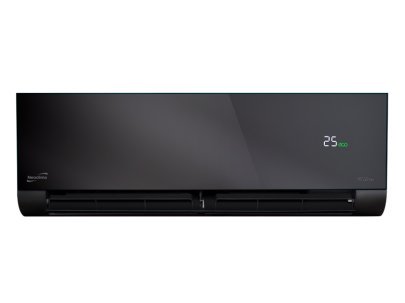
Of course, air conditioning is considered economical and efficient equipment. On average, its efficiency is equal to 200-250%.
Also, the advantage of the air conditioner is that it will be useful not only in winter, but also in summer, since no one has canceled hot days and stuffiness in the room, in our climate. In a way, this is a universal equipment that can control and create a comfortable climate in the store all year round.
There are several points of cons:
- price ( a good inverter air conditioner that can work in severe frost will not be cheap);
- maintenance (it is important to service the air conditioner several times a year, depending on the intensity of use);
Also, to help the air conditioner, you can hang a special polymer film, in the form of vertical stripes, in the complex - the loss of heat or cold will be significantly reduced!
Air curtain - like a heater
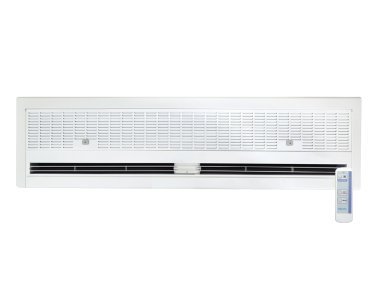 Let's consider another way to keep warm or heat a commercial space - an air (thermal) curtain. This method is ideal if the question is only about heat.
The air curtain blocks the entry of cold air and the exit of warm air, thus, if the front door is opened frequently, the temperature in the room will not change. The thermal curtain is installed above the entrance door, and the flow of air released by it is directed downward, thereby creating an "air wall" that separates the room from the external environment, like a door. Depending on the type, air curtains are divided into:
- without heating (creates a partition of the external and internal environment with an air flow);
- with electric heating (in addition to preventing heat loss, it heats the air in the room using a heating element or STICHA);
- with water heating (it is considered more difficult equipment than the previous two, since it is also connected to water supply pipes).
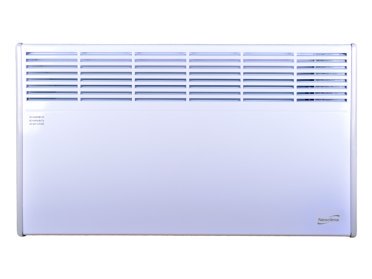
Electric convectors
Why simple?
Because the equipment itself is elementary in action. And expensive, because the efficiency is equal to the consumption of electricity. That is, in order to produce 2 kW of heat, the convector needs 2 kW of energy.
It is difficult to call such equipment economical. But quite convenient and mobile. You can use it anywhere where there is an outlet, it can be installed both on the wall and on the legs (wheels).
This type of heating of the store and the premises as a whole can rather be called additional. Using it as the main, permanent source of heating is expensive and not very efficient.
